

Polo Rocha is a contributing writer for Bank Director.

Why Deposit-Focused Banks Outperform on Margins
There is perhaps no financial measure that better captures the essence of banking than the net interest margin. Boosting this metric was a key component to the success of the year’s top RankingBanking performers.
Close
About the authors

Written by
Polo Rocha
Contributing Writer
Polo Rocha
Contributing Writer
*This feature is part of the 2026 RankingBanking report.
There are plenty of metrics to evaluate a bank, but few are as effective as net interest margin. It is, after all, one that captures the age-old business model of banking: Lend money at a higher interest rate than you pay on your deposits.
It’s a model that can take many variations. It can work for small community banks in rural areas, or those in hot urban markets. It can work for banks with $1 billion in assets, those pushing $10 billion or those far north of that mark. And it can work for those who find industry niches within banking — or those whose niche is the community they call home.
“For every bank, for all of time, the net interest margin has been the driver of success,” says Charles “Skip” Hageboeck, CEO of City Holding Co., parent company of City National Bank. “If you don’t have a sufficient margin, you can’t afford the expenses to go along with the bank, usually.”
The $6.8 billion City Holding in Charleston, West Virginia, is among the top performers on this year’s RankingBanking, which is sponsored by Crowe, a professional services firm. The list uses four metrics — return on average total assets, return on average tangible common equity, tangible common equity to tangible assets and nonperforming assets to loans and other real estate owned — to rank the 300 largest publicly traded banks. This year’s ranking uses 2025 results and was calculated by Piper Sandler & Co. using data from S&P Global Market Intelligence.

Overall, the study highlighted how strong NIMs can propel banks to the top. The overall top 25 banks had median NIMs of 4.11% for 2025, far above the 3.57% median among other banks in the ranking, according to an analysis Piper Sandler conducted.
Strong customer relationships were key. Bank deposit costs have jumped since the Federal Reserve hiked interest rates aggressively in 2022. But those with large pools of loyal “core” depositors fared better, particularly if they did the nuts-and-bolts work of gathering noninterest-paying checking accounts.
“Getting core deposits is the name of the game,” says Christopher Marinac, director of research at Brean Capital.
That deposit buffer may help those banks in the months ahead. Markets expect the Fed to hike rates again now that inflation is on the rise, dashing the pre-Iran war hopes of more rate cuts.
Rate hikes aren’t necessarily negative for banks, Marinac says, since existing low-yielding loans and securities that are finally maturing will now reprice at higher interest rates. But they do mean that deposit competition could pick up again, weighing on bank NIMs.
“The margin is probably going to hang in there, [but] I do think the cost of funds is a challenge,” Marinac says. “I don’t think it’s going to go away.”
A Short-Lived Recovery?
Renewed pressure would follow last year’s NIM recovery. Margins were on the upswing after coming under some pressure in 2023 and 2024, when rate hikes and the failure of Silicon Valley Bank put stress on the banking industry.
Deposit competition, which was muted when interest rates were at 0%, heated up as consumers and businesses sought to get paid more for their cash. Banks, pressed to avoid any deposit outflows, were forced to pay up.
Even if overall industry NIM metrics didn’t dip too much, some banks saw “very, very, very low NIMs” in 2024, says Kara Baldwin, partner and financial services audit leader at Crowe. Low yields on pandemic-era securities and loans collided with rising deposit costs to squeeze some banks’ profits.
Last year was quite a bit better, as the Fed pivoted toward rate cuts late in 2024 and eased deposit cost pressures.
“Just about everybody was able to grow that out — adjust and adapt,” Baldwin says, adding that “2025 was a better-margin year.” 
It was even better for the top performers on the RankingBanking list, thanks in part to high-quality deposits. The top 25 banks had an average cost of deposits of 1.52% at the end of 2025, beating the 1.94% average for other banks in the study, according to Piper Sandler.
One reason why: their outsize pools of noninterest-bearing deposits.
Deposit Buffer
Noninterest-bearing deposits are the checking account that consumers use to cover rent, buy groceries and pay their bills. Or they’re the main transactional account for a business paying its suppliers and employees.
Those “operational” funds flow in and out, and their on-demand nature means they generally do not pay interest — unlike certificates of deposit and other savings-oriented products. So, when interest rates rise, banks with larger shares of checking accounts tend to benefit.
That includes Bank First Corp. in Manitowoc, Wisconsin, which came in at No. 6 on the RankingBanking list. Executives at the $5.9 billion bank view primary checking accounts as the “linchpin” of customer relationships, says Timothy McFarlane, the bank’s president.
When someone tells a friend where they bank, he says, they don’t list their home equity loan, boat loan or mortgage — but where their paycheck lands.
“Every day, we get up, and we fight to win those accounts. And then once we win them, we fight to keep them every day,” McFarlane says, highlighting the bank’s focus on “top-notch” customer service and dutifully resolving any complaints.
Bank First doesn’t have a specific target for NIM, he says. But the bank’s margin “ends up looking pretty favorable,” he adds, thanks to some 30% of its funding base coming from noninterest-bearing demand deposits. Its NIM was 4.13% in the second quarter, according to the bank’s earnings release.
Noninterest-bearing deposits aren’t free, says Rajdeep Sengupta, a senior economist at the Federal Reserve Bank of Kansas City who focuses on banking. Bankers note they invest heavily in their branch networks, online tools and in their employees — all of which keeps customers happy without taking their money elsewhere.
But during the sharp post-pandemic rate hike cycle, those noninterest-bearing deposits were a key differentiator between banks whose NIMs rose and fell, according to a 2024 paper that Sengupta co-authored.
Lacking such buffers, other banks’ interest-bearing deposits adjusted quicker to the Fed’s hikes. Banks also turned to capital market sources for non-deposit funding, where banks effectively have to “pay what the market is asking,” Sengupta says.
When rates were low, those sources of funding were cheaper. But the “costs increase much more rapidly” when interest rates rise, he adds.
Building the Moat
Building a deposit buffer is easier said than done. At smaller institutions in more rural markets, bankers rely on deep relationships across the community — banking many households rather than focusing on high-ticket customers.
“We have a high number of accounts and customers, and we’re very proud of that,” says Mark Gooch, CEO and chairman of Community Trust Bancorp in Pikeville, Kentucky. The $7 billion bank was No. 22 on this year’s RankingBanking list. “We don’t have to depend on large dollar amounts. … If you’ve got enough $700 or $800 noninterest-bearing accounts, you can do pretty well.”
For some banks, deposits have long been an afterthought, says City National’s Hageboeck. But he sees “deposits as being our primary business, not something we do to fund our loans,” he says.
Hageboeck rattles off statistics on City National’s deposits, such as the large share of demand deposit accounts having an average of $1,000 at any given time. The core of retaining those deposits, he says, is delivering “excellent customer service, all the time, to all the customers.”

“When you have small balances, you’re more interested in the service that you get from your institution, and that’s a hallmark of City,” Hageboeck says.
At Bank First in Wisconsin, the philosophy of core deposits and quality customer service has survived several mergers over the last decade. It announced its latest in May, when the bank struck a deal with PSB Holdings in Wausau, Wisconsin.
The key, McFarlane says, has been ensuring any merger partner has a similar philosophy and deposit makeup. That means digging deeper than the usual bank proclamation that they’re “relationship based,” he says.
“Very early on we ask: How do you define that? How many of your loan customers have their primary checking account with you?” he says. “If that answer is low, we probably can’t successfully integrate that.”
Regional Strength
The $53.9 billion Cullen/Frost Bankers is similarly focused on gathering core deposits across its Texas markets, whether from businesses or consumers.
It’s so focused on customer relationships that the word transaction gets a “visceral reaction” at the San Antonio-based bank, says Chief Financial Officer Dan Geddes.
“Our bankers don’t get credit for bringing in a relationship if it’s not their checking account,” Geddes says. “Because of that, we are able to have what we feel like are, if not the lowest, one of the lowest cost of deposits in the marketplace.”
That fueled a rise in Cullen/Frost’s net interest margin when rates went up, helping it rank highly among banks with over $50 billion in assets. Its NIM ticked up from 2.33% in the first quarter of 2022 to 3.47% a year later — and it’s stayed similarly high ever since, even throughout the industry’s mini-crisis in 2023. The bank’s been able to “maintain a really healthy net interest margin, despite some challenging interest rate environments that we’ve been in,” Geddes says.
Its Texas footprint opens it up to aggressive competition, with big and regional banks making a big push in the Lone Star State. Cullen/Frost is expanding as well, deepening its branch network across Texas.
But it’s avoiding chasing larger corporate clients, which Geddes says is the “easiest way to grow a new footprint.” More competition for big clients would mean earning tighter yields on loans, lowering the bank’s NIM, he notes. Instead, the bank is focused on building a large client base of smaller and medium-size businesses — where the bank can grow alongside its customers without sacrificing margins.
It all goes back to the bank’s mission statement, says Geddes, who started at the bank in 1997. He holds up a copy of the 19-word statement: “We will grow and prosper, building long-term relationships based on top-quality service, high ethical standards, and safe, sound assets.”
Focusing on safety helped the bank’s margin the last few years, Geddes says. Its strategy to carry more liquidity gave it more options when the banking industry saw stress in 2023, he notes. And Cullen/Frost was a similar safe haven when banks pulled back on lending after the 2007-09 financial crisis, he says.
“You may lose in the short term,” Geddes says, as the full scale of the bank’s balance sheet isn’t deployed in higher-yielding assets. “But when there are downturns, you’re in a great position to not only survive but thrive.”
Finding a Niche
For other banks, the key has been focusing on a specific industry niche.
That’s the story for Esquire Financial Holdings in Jericho, New York, which since its 2006 founding has focused on serving the banking needs of plaintiff law firms. It also has a national merchant acquiring platform in addition to offering more traditional community banking services.
The litigation industry made up roughly 78% of Esquire Financial’s deposits at year-end, according to the bank’s annual report. Much of that is in longer-duration escrow and settlement accounts, which are far less rate sensitive than a typical business deposit.
CEO Andrew Sagliocca says lending to the industry — not just taking their deposits — was key to getting started given the expensive nonbank lenders that have been traditionally available to law firms. It’s a sector that banks didn’t lend to years ago, given the irregular cash streams for plaintiff firms as they wait for case payouts. The $2.5 billion Esquire landed at No. 3 on this year’s RankingBanking list. 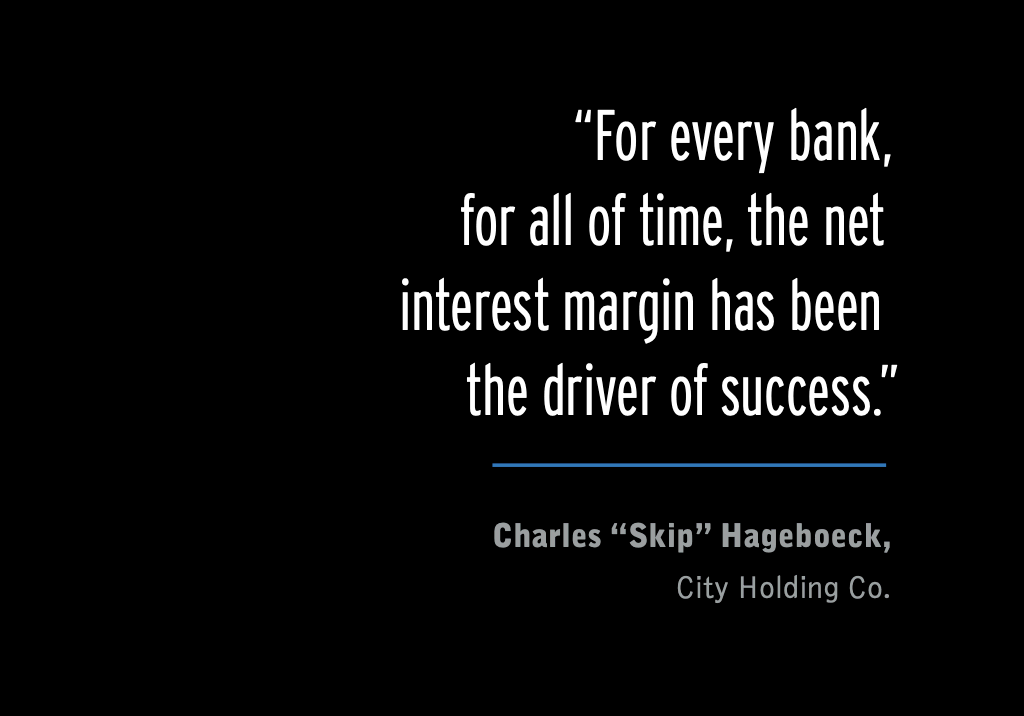
“That makes lenders nervous,” Sagliocca says. “Bankers and lenders don’t understand contingent collateral. They don’t understand the value of it, the duration of it, and they don’t like underwriting against irregular cash flows.”
The industry is “fragmented. It’s large, it’s complex, at least to other people,” he says, which is what makes it compelling. “We live and breathe this vertical every day,” he says, and clients are able to call him and the management team directly.
That level of service “hopefully earns me the right to ask for your operating and escrow accounts,” he says.
Not the Only Metric
For all the strengths of NIM, it’s far from the only way to measure a bank’s performance.
Sengupta, the Kansas City Fed researcher, says the “meat-and-potatoes banking model” of taking deposits and making loans boosted some banks’ NIMs as rates rose. But those whose NIMs underperformed did better on their fee income, including with capital markets operations.
“Whichever strategies banks choose to apply, both are profitable,” Sengupta says. “It’s just that the sources of profits are different.”
It is why Brean Capital’s Marinac tends to prefer looking at pre-provision net revenue — which includes fee income as well as banks’ general expenses. NIMs are a “piece of the puzzle,” Marinac says, but investors can sometimes get too focused on margins rather than more holistic measures.
Even so, he notes, high-performing banks have found success by gathering sticky deposits and ensuring that their relationships aren’t just based on loans. “The ticket for most banks is that they have to get the loan and deposit relationship synced,” he says. “You can’t just talk about, ‘We’re going to get the deposit account later.’ You have to get it now. You have to incent and reward behavior. You have to pay your people to bring in deposits.”
People Focused
Keeping a strong NIM despite today’s competition is a “constant battle,” says Community Trust’s Gooch. But it is one the bank succeeds in despite customers getting more rate sensitive over the years.
“As long as you take care of them, provide them their financial needs — whether it’s on the lending side, whether it’s the brokerage side or the trust side — they’ll have at least a degree of loyalty,” he says.
Even as more of its customers opt for Community Trust’s online banking tools, the bank remains a presence at local events, he says.
It’s “hard to find a scoreboard” in its markets without its name, he says, and bankers volunteer in local organizations consistently. Gooch notes the generations of customers and families that the bank has grown alongside with.
“If they’re successful, we’re successful, and we’ll continue to grow,” he says.
It is a “tough model,” he acknowledges, and it requires investing in the same types of online tools that big banks offer, he says. But “the biggest tool that we have is our people,” he says.
“It’s not the easiest model to do, but if you’ve got good people, it’s one that works,” he says. “It allows us to perform in the upper echelon compared to other banks our size. We hope to continue doing that.”
WRITTEN BY
Polo Rocha
Contributing Writer
Polo Rocha is a contributing writer for Bank Director.