

Polo Rocha is a contributing writer for Bank Director.

Regulators Raise Definitions of Small Bank Amid Push to Ease Burdens
The $10 billion asset threshold remains key, but regulators are making changes below and above that.
Close
About the authors

Written by
Polo Rocha
Contributing Writer
Polo Rocha
Contributing Writer
As a U-turn continues in Washington D.C., regulators are taking one simple approach toward easing rules for community banks: redefining what counts as a smaller bank.
The $10 billion asset threshold remains critical, lawyers and analysts say, marking a bright line that subjects banks to stronger oversight. But regulators are tweaking north and south of the $10 billion line, lightening the burdens of what bankers say became a regulatory approach too focused on process, not risk.
The changes, some of which aren’t finalized, are wide ranging. They cover the frequency of bank exams; guidance on working with third parties; lending to bank executives and directors; audit rules; and the Community Reinvestment Act.
“Adjusting all these different little things, on the whole, makes a difference,” says Kate Wellman, a Charlotte-based bank lawyer at Moore & Van Allen.
Regulators are also tying more asset thresholds to inflation, so that they don’t get out of whack years from now. That may result in more regulatory tiers to track — and fewer round numbers thanks to inflation-adjusted thresholds. The flip side is that regulation will become less one-size-fits-all, says Doug Weissinger, a Memphis, Tennessee-based bank lawyer at Butler Snow, focusing the strictest rules on the largest institutions.
“This better helps the regulators and the banks have a tailored regulatory enforcement structure,” he says. “I feel like bankers have been asking for this since I’ve been practicing.”
Policy Debate
The easing is drawing concerns from some advocacy groups, who worry about loosening safeguards introduced after the 2008 financial crisis.
Bankers “routinely overstate the burden of regulation,” which ultimately guards against excessive risk-taking with local customers’ funds, says Bartlett Naylor, a financial policy advocate at Public Citizen. “Small banks without good capital and supervisory standards attract vultures,” he says. “This proved the recipe for the S&L crisis of the 1980s.”
Industry groups say regulators are making much-needed updates, since many asset thresholds were set two decades ago when the U.S. economy was half its current size. The changes “are really about recalibration, not deregulation,” says Amy Ledig, vice president and regulatory counsel at the Independent Community Bankers of America, the trade group for community banks.
“The objective is not to remove core safeguards, but to make sure requirements remain proportionate to risk and complexity instead of becoming more restrictive every year due to inflation or economic growth,” Ledig says.
Exams Every 18 Months
On Capitol Hill, lawmakers of both parties seem sympathetic to that argument.
In a sweeping housing law passed this July, Congress allowed banks with under $6 billion in assets to qualify for supervisory exams every 18 months, not every 12. The prior threshold was set at $3 billion. Only well-managed banks qualify for the extension.
It is a change that bankers are welcoming, says James Stevens, an Atlanta-based lawyer at Troutman Pepper Locke, since it’ll reduce how often bank staff gets tied up preparing for exams. “Exams are very, very disruptive,” he says. “It takes a lot of time to get ready for them, to deal with the examiners when they’re on site and then to deal with whatever comes out of that. Even if it’s nothing bad, there’s still follow-up.”
But a longer timeline means banks will sort through more transactions and credit decisions during exams, says Peter Dugas, a Washington, D.C.-based bank consultant who is founder and CEO of the Regulatory Intelligence Group. “That’s six more months of data,” he says.
$30 Billion Rule Change
The change is tougher to roll back since it’s hard-coded into law, Dugas says, as opposed to other tweaks driven by regulators.
Those include changes defining community banks as those with less than $30 billion in assets. That threshold showed up last month in the Federal Reserve’s new proposed regulatory guide for traditional community banks on risk management when working with fintechs and other third parties. The Fed is taking comments on it until Nov. 16.
The Office of the Comptroller of the Currency is now lumping in banks below that mark into its community banking supervision group.
The Federal Deposit Insurance Corp., meanwhile, is using the same $30 billion mark in a proposal to slightly lower the assessments that banks pay into the agency’s insurance fund.
In a comment letter, a pro-regulatory advocacy group Better Markets said it isn’t opposed on principle to increasing the $10 billion threshold. But it did ask for more data backing the change, saying that inflation adjustments shouldn’t “become a vehicle for a broader substantive deregulation.”
Under $10 Billion Threshold Changes
Regulators are also weighing raising the $100 billion threshold for regional bank regulations and $700 billion mark for super-regionals, according to Reuters. But they’ve already taken action on a series of changes for banks with less than $10 billion.
One major one is an FDIC change to audit requirements for small banks.
Previously, the FDIC required banks above $500 million in assets to annually submit their audited financial statements and a report from an independent accountant. They were also required to have an audit committee with mostly independent members. That is now $1 billion.
Banks with more than $1 billion in assets also needed auditors to attest that the banks had internal control over financial reporting — a process that can flag material weaknesses in accounting procedures. The FDIC raised that to $5 billion.
Yet another pending change would raise the actual dollars that banks can lend to executives and directors. The Federal Reserve’s Reg O thresholds haven’t been raised since 1994, a staff memo says, which the Fed says can dissuade community members from joining bank boards. In one such adjustment, the rule would increase the lending threshold for executives to $400,000, up from $100,000. Comments on the proposal are due Nov. 4.
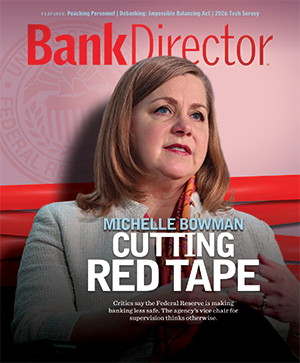
Michelle Bowman, the Fed’s vice chair for supervision, said this month in a speech that the agency is working to revise other outdated asset thresholds.
“Every standard reflects a policy decision at a particular point in time, but over time, without adjustment, policy judgment is replaced by a miscalibration,” she said, putting those thresholds at risk of becoming “irrational.”
CRA Debate
The biggest headline-grabbing change is the Community Reinvestment Act, which the OCC and FDIC proposed overhauling in July. The Fed has not signed onto the proposal. It would raise the “small bank” threshold that subjects lenders to fewer requirements to $1 billion, up from $412 million. An “intermediate” category would now include banks of up to $10 billion, up from $1.649 billion.
The FDIC and OCC said that would “address the mismatch that has emerged between the current thresholds and a dynamic industry.”
Hundreds of small banks would no longer undergo evaluations for community development work, according to the National Community Reinvestment Coalition, which advocates for stronger CRA requirements. That could affect bank investments in low-income housing tax credits, the group said in a summary. Raising the intermediate threshold to $10 billion, the NCRC added, would put “thousands of branches in underserved communities at greater risk.”
Michael Emancipator, a senior vice president at the ICBA, says the current rules subject community banks to the same evaluations as the largest institutions. “Recalibrating thresholds allows community banks to redirect scarce compliance resources toward what the CRA is ultimately meant to promote,” he says.
Political Swings
Regulatory actions are vulnerable to a complete change if a Democrat were to win the White House in 2028, cautions Dugas, of the Regulatory Intelligence Group. That could include future regulators faulting banks for decisions that pass regulatory scrutiny today, he says.
He advised community banks to keep preparing for growth — well before whatever asset threshold would trigger a new regulatory requirement. After all, he says, banks need to manage the risks they’re facing even if their regulators aren’t pressing them as much on process and documentation.
“While it’s helpful to have these increased thresholds for which a bank must be examined, it doesn’t change the risk to the financial institution itself,” he says.
WRITTEN BY
Polo Rocha
Contributing Writer
Polo Rocha is a contributing writer for Bank Director.