


Editor-in-Chief Naomi Snyder is in charge of the editorial coverage at Bank Director. She oversees the magazine and the editorial team’s efforts on the Bank Director website, newsletter and special projects. She has more than two decades of experience in business journalism and spent 15 years as a newspaper reporter. She has a master’s degree in journalism from the University of Illinois and a bachelor’s degree from the University of Michigan.

Commerce Bancshares’ Rise To Become One of America’s Best Banks
Here’s how a straightforward business model and fee income propelled a Missouri institution to the top of this year’s RankingBanking list.
Close
About the authors

Written by
Naomi Snyder
Editor-in-Chief
Naomi Snyder
Editor-in-Chief
*This feature is part of the 2026 RankingBanking report.
The lobby of the 15-story Commerce Bank Tower in a suburb of St. Louis is decked wall-to-wall with a video installation of a pristine Missouri prairie, a colorful canvas of wildflowers waving in the wind.
The nod to Missouri before it had much development is not an accident. The $35.2 billion Commerce Bancshares, based in Kansas City, traces its history in the Show Me State back more than 160 years — starting shortly after the Civil War. The Kemper family has been involved almost that long. And that longevity seems built into its DNA. The sixth-generation Kemper now running the publicly traded bank, 48-year-old John Kemper, hews to a pattern similar his predecessors. He has a focus on customers, credit and sustainability through good times and bad.
In an age of social media hype and attention-grabbing headlines, Commerce may fly under the radar at a national level. But it’s quietly built a powerhouse banking franchise with high profits, strong capital and excellent credit, a formula so successful that it’s the No. 1 bank overall in Bank Director’s 2026 RankingBanking based on 2025 results.
RankingBanking is an annual measurement of the 300 largest publicly traded banks by asset size. Each bank is ranked using four metrics: return on average total assets, return on average tangible common equity, tangible common equity to tangible assets, and nonperforming assets to loans and other real estate owned.

But Commerce taking the top spot this year isn’t a fluke. The bank has consistently outperformed other banks on those metrics over the years.
Commerce’s return on average assets for the past 30 years dipped below 1% only once — in 2009, when it bottomed out at 0.9%. It sailed through the 2007-09 financial crisis relatively unscathed compared to other banks. It also outperformed most banks in its asset class in 2020, the year of the onslaught of Covid-19. Its return on tangible common equity has been in the mid-teens since 2021, ending 2025 with 16.39%.
And while some banks juice profits by lowering capital or stomaching worse credit, Commerce’s capital ratio in 2025 was higher than 116 of the 142 banks in its asset class; its asset quality ratio was better than 137 banks.
“The model’s been quite deliberate over the course of several decades, and it really shows through in terms of their results and just the overall profitability profile of the franchise,” says Nathan Race, who follows the bank as a managing director and analyst at Piper Sandler & Co.
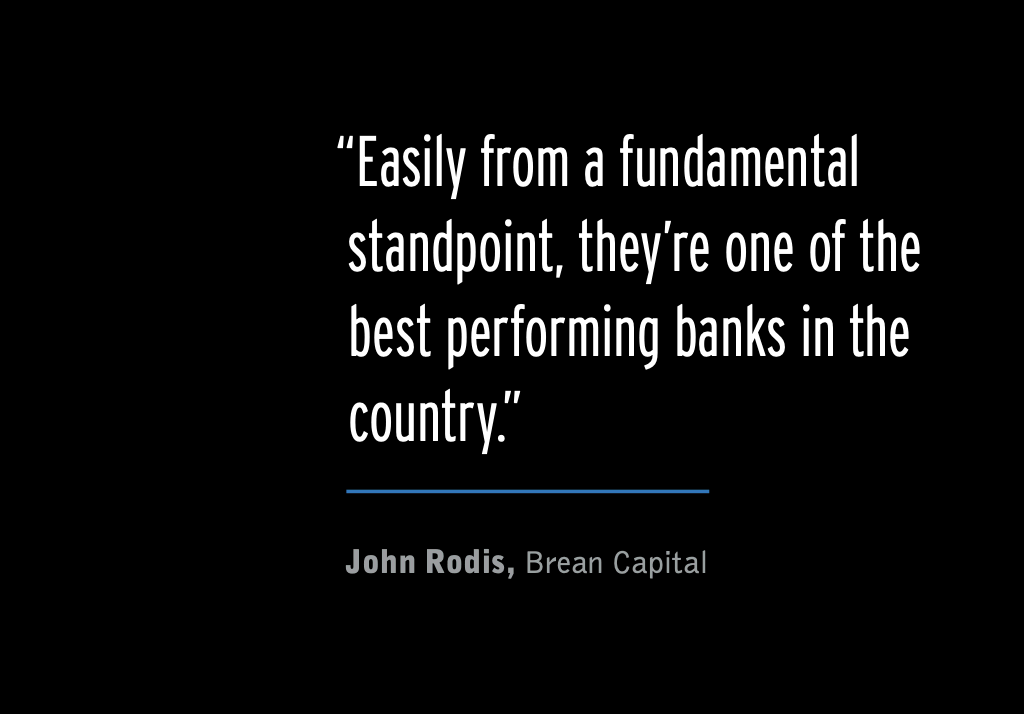
John Rodis, an analyst and managing director at Brean Capital, says he’s been following the bank since he started his career in St. Louis with Stifel Nicholas in the late ‘90s. “Easily from a fundamental standpoint, they’re one of the best performing banks in the country,” he says.
A Family Legacy
To understand Commerce’s success, it’s important to understand the bank’s roots. The Kemper family traces its ties to the bank back to 1881, when an entrepreneur and physician named Dr. William Stone Woods bought a controlling interest in the Kansas City Savings Association. He renamed it Bank of Commerce, according to a book commissioned by the bank and published in 2015. Woods was careful to teach his employees about the importance of credit. He wrote to a nephew: “The fact is most banks make enough money if they keep out of bad debts, and as I said to you by word of mouth, I will forgive you for almost anything but bad debts.” Commerce Bank survived multiple bank panics and the Great Depression, all before the Federal Deposit Insurance Corp. was created in 1933. The Comptroller of the Currency briefly closed the bank during the Panic of 1907, but Woods managed to reopen it in 1908 without any of its depositors losing a dollar, according to the book.
Woods eventually recruited an executive named William Thornton Kemper — who ran the bank and also bought a controlling interest in City Center Bank, now known as UMB Financial Corp., in 1918. (Just to add to the family’s banking dynasty, UMB still exists and is run by John Kemper’s cousin, Mariner Kemper.)
 Kemper’s family tree would join with the Woods family. Woods’ granddaughter married Kemper’s son, James M. Kemper Sr. Remarkably for a publicly traded bank, the Kempers continue to helm top leadership positions. The sixth generation, John Kemper, who is now CEO, was born in Kansas City. John was the oldest of four children. When he was 7, the family moved from Kansas City to St. Louis, because the bank had bought County Tower Corp. and his father, David Kemper, was sent to build Commerce’s presence in the city.
John is the only one of his siblings to work at the bank. His sister Ellie Kemper is a well-known actress who played Erin Hannon in the U.S. version of the television show “The Office.” His other sister, Carrie Kemper, is an Emmy-award winning screenwriter. Even John’s brother moved to Los Angeles.
John explains this by saying his father encouraged his children to follow their passions.
John did so, and majored in history and political science at Stanford University and has graduate degrees from the London School of Economics and Northwestern University. On graduating, he followed a well-worn path to a startup tech company but later became a consultant for a variety of industries at McKinsey & Co. in New York and Chicago.
John came to the bank in 2007 to lead strategic planning when his dad was still CEO. John took the helm in 2018 at the age of 40. His father has remained involved with the bank as executive chairman, though the bank declined an interview request with him.
John is an attentive conversationalist, a skill probably learned around the dining room table with his grandmother, Mildred Kemper, who forbid talk about banking. Her argument for the prohibition: “‘There’s so many other interesting things to talk about,’” he recalls.
Kemper is the sort of person who strikes others as thoughtful and curious, probably born out of his years as a consultant. “He welcomes feedback and guidance,” says W. Kyle Chapman, who serves on the Commerce board and is the CEO of a global manufacturer based in St. Louis. “John is incredibly smart and so he could easily not do that, but he really just engages with us as a strategic partner as we oversee the business.”
To remain competitive, Kemper has encouraged staff to rip a page from the technology startup playbook. Instead of waiting until a new service or technology is perfect before launching for all customers, the bank now tests products and tech with smaller groups of customers. “We used to talk, talk, talk,” says Paula Petersen, executive vice president. Now “we put our toe in the water, test it, tweak a little bit and get our way to ‘yes’ much quicker.”
This has been a handy tool in the fast-paced world of payments, an important business for Commerce and where technology such as stablecoin may threaten bank deposits. So far, Kemper says customers aren’t asking for stablecoin, but if they do, he wants Commerce to provide what they want or need.
Kemper devotes a lot of time to talking to customers — a lesson learned from his father, who learned it from previous generations of Kempers. When William Thornton Kemper would finish his work for the day, he hung out in the bank lobby in Kansas City to catch up on the latest news.

“John would, and his dad was the same way, they would rather spend time with customers than spend time with Wall Street,” says Charles “Chuck” Kim, the bank’s CFO. That means Kim is the executive most likely to travel to New York for investor meetings. “And frankly, some of them complain a little bit, ‘I don’t get to talk to John enough,’” Kim says. “If they want to come here and see us, John talks to them, and he’ll talk strategy, but he is very committed to the business and responsible, profitable growth in the business.”
John Kemper’s preferences about how to spend his time are evident in the absence of quarterly guidance given to analysts. There are no earnings calls — instead, the bank schedules one-on-ones with analysts who cover the bank. “Make no mistake, we work for our shareholders,” Kemper says. “But we want to be as transparent as possible about what our strategy is, what our results are, disclose everything, and let the numbers speak for themselves.” He adds that the executive team wants to prioritize execution — and that means helping customers focus on what matters most — instead of worrying about hitting guidance numbers.
“I think some banks do spend a lot of time, I don’t want to say, constructing a story, and a little less time focused on the things that actually go into that story,” he says. “We’re really focused on execution.”
The Secret to Success
Given the Kemper family’s long ties to Commerce, outsiders may wonder if nepotism is what landed John his CEO job. But that concern is dissuaded by the bank’s strong performance, Race says. There are a few aspects that help drive the bank’s success.
For one, David and John alone own slightly less than 5% of outstanding shares, according to the bank’s spring 2026 proxy filing. John Kemper owns 1.2%, worth nearly $100 million as of mid-July. Investors usually like management as owners — the thinking is that executives will do a better job if their own personal net worth is tied to the success of the company.
Commerce also has a unique geographic structure to its management team. About half of the company’s executives live in Kansas City and the other half in St. Louis — the two urban pillars of the deposit franchise. The CEO and CFO are based in St. Louis, and other executives such as Petersen are in Kansas City. Nearly every day, a private plane jets them across the state. The family is perhaps best known in Kansas City, the bank’s longtime home. It’s where John’s uncle Jonathan lives and is now retired after also working for the bank. “I can’t think of a philanthropic or civic event I’ve been through where they don’t know Jonathan or David,” Petersen says.
There are other aspects about the business model that truly drive Commerce Bank’s success. When it comes to performance, Kemper says he has a scorecard that he shows to the board. It’s similar to RankingBanking in that it looks at returns and capital but also has a strong emphasis on credit. “They never compromise credit for growth,” Chapman says. Kim agrees. “We’ve been in business 160-plus years. We manage the business to be around another 160 years,” he says.

Secondly, close to 40% of the bank’s income is fee-based, especially coming from its payments division, which includes credit cards, and its trust and wealth management business. Chapman and Kim both say the bank’s business model is strong because of its low-cost deposit franchise, built on decades of being present in Missouri and southern Illinois. Low-cost deposits, combined with high fee income businesses and strong customer relationships, have fueled Commerce for decades. “We tend not to go toward single dimensional things,” Kim says. “Even our credit card portfolio is very well penetrated into our deposit portfolio.”
The drawback to that model is that investors view the bank as low growth compared to peers. High single-digit loan growth is about as juiced as Commerce’s performance gets, Kim says. That has led the stock to fall more than peers this year, analysts say.
“Commerce has just focused on banking some of the highest quality companies, commercial businesses across their footprint in the Midwest,” Race says. “Some of those businesses are more mature in nature and aren’t investing and don’t have as much in terms of capital needs or needs to draw lines of credit.”
The bank still trades at a premium to peers — as of late July Commerce was trading at a price to tangible book value of 214% compared to a peer group of 175%, according to Rodis. Its price to earnings ratio for fiscal year 2027 was 13.1% compared to a peer group of 10.5%.
Growing Into Growth Markets
The bank has been trying to counterbalance its slower growth in the Midwest by entering faster growth areas in recent years. It entered Denver in 2007, Nashville, Tennessee, in 2008, Dallas in 2012, and Houston in 2018. It also made a $520 million acquisition this year of a bank in Florida, FineMark Holdings of Fort Meyers, which the executive team says had a complementary business in trust and private banking. In addition, some of Commerce’s customers have second homes or businesses on the western side of Florida, close to the 13 branches recently acquired. It also announced in June the planned purchase of an investment banking firm in St. Louis to support business clients.
The acquisitions stood out for Commerce, which rarely engages in M&A. Its last bank purchase was of Summit Bancshares in Tulsa, Oklahoma, 13 years ago. In the end, culture matters, and it’s hard to find another bank that will fit Commerce Bank’s credit standards. “You’re wholesale adding a lot of things to your balance sheet,” Kemper says. “You’d better be sure about what those things are.”
Not everyone is a good fit for Commerce, either. “We value people who are collaborative,” he says. “We value people who like to work on a team. We value people who are curious.” The people who don’t do well are the “stars,” which he describes as people who are focused on themselves.
Kemper reflects on all of this and what has made his tenure a success from a conference room in the Commerce Bank Tower. Behind him, yellow wildflowers wave in the breeze from a rooftop garden. He admits the business model is simple enough, with its high fee income, low-cost deposits and strong credit. “We’re obsessed with taking care of our customers and building longstanding relationships,” he says. “If our eyes are on the field and not on the scoreboard, and we’re really taking care of our customers, that’s what’s going to create the results that you see at the end of the day.”
WRITTEN BY
Naomi Snyder
Editor-in-Chief
Editor-in-Chief Naomi Snyder is in charge of the editorial coverage at Bank Director. She oversees the magazine and the editorial team’s efforts on the Bank Director website, newsletter and special projects. She has more than two decades of experience in business journalism and spent 15 years as a newspaper reporter. She has a master’s degree in journalism from the University of Illinois and a bachelor’s degree from the University of Michigan.