

Charbel Safadi is Chief Executive Officer of Zafin. Zafin is an AI platform company for regulated institutions. Built from more than 20 years of experience operating in demanding regulated technology environments, Zafin brings structure, intelligence and accountability to how critical work, systems and decisions are created, governed and improved.

Governing Agentic AI’s Autonomous Execution
Boards do not need to oversee every decision made by autonomous agents. But they do have a responsibility to ensure management is properly governing how these systems act.
Brought to you by Zafin

Close
About the authors

Written by
Charbel Safadi
Chief Executive Officer
Charbel Safadi
Chief Executive Officer
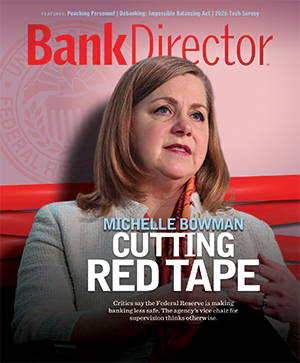
*This article appears in the fourth quarter 2026 issue of Bank Director magazine.
Bank boards have spent the last two years overseeing artificial intelligence adoption. What began as AI assisting bankers across relationship management, compliance and operations is rapidly evolving into agentic AI executing work on the institution’s behalf. Autonomous agents are beginning to make operational decisions and carry them out at machine speed, changing not only how banks operate but also what boards are expected to govern.
The Goldman Sachs Group has deployed an autonomous coding agent across its engineering workforce to read, refactor, test and ship changes to legacy systems. Across the industry, institutions such as JPMorgan Chase & Co. are embedding AI into production workflows at enterprise scale, with similar forms of autonomous execution emerging across financial services.
As autonomous execution expands, boards face a new governance responsibility: ensuring that every autonomous action remains observable, accountable and provable on demand.
Institutionalized Opacity
The deeper governance challenge predates AI. Between policy design and customer outcome sits an execution layer that few institutions govern end to end, creating a gap between approved policy and what is executed. Autonomous execution did not create that gap. It simply exposed it and accelerated it.
Banks have long managed inconsistent execution. Similar customers receive different outcomes, negotiated pricing is not reflected in billing, and compliance teams reconstruct decisions after the fact.
These issues are already difficult to explain and trace across traditional systems. Autonomous agents make that challenge harder by increasing the volume and velocity of decisions.
Without governance built into the execution layer, institutions lose visibility into how decisions are carried out long before they lose control of the outcomes. The issue is no longer simply whether execution aligns with approved policy. The institution must also be able to show who or what is authorized to act, whether execution stays within that authority and what evidence proves it. That evidence needs to be designed into the execution architecture, not reconstructed after the fact.
The Governance Trap
When governance gaps appear, the instinct is to respond with additional reporting, approvals or periodic reviews. Those measures may help explain what happened yesterday, but they cannot govern autonomous execution in real time.
Governance cannot depend on controls applied only after deployment. Agents need to work within defined authority and policy, with clear human accountability and evidence generated as work is carried out. Institutions that scale autonomous execution without these controls risk regulatory, reputational and operational consequences.
For boards, explanation alone is no longer enough. They should expect proof of work: evidence that autonomous actions remained within approved authority and policy.
What Boards Should Ask Management
Governing autonomous execution requires a different standard of evidence. Boards should ask three questions.
- Who or what was authorized to act? Every autonomous action should be attributable to an approved authority, with clear boundaries around what the agent was permitted to do.
- Did execution remain within those boundaries? Management should be able to demonstrate which policies and controls governed the action and where human accountability remained.
- Can you prove it today? Evidence should be generated as decisions are executed, not assembled later after a regulator, auditor or customer asks the question.
Together, these questions establish three practical expectations: traceability, human accountability and proof on demand. Autonomous execution does not transfer accountability. It changes how accountability must be demonstrated.
The Governance Imperative
As these systems take on more work, so does the board’s need for evidence. When challenged, management needs to show not just the outcome but the authority, policy and evidence behind it. Regulators have made AI governance a standing topic in supervisory discussions, yet existing model risk guidance does not yet fully address generative and agentic AI.
Boards do not need to govern every autonomous decision. They do, however, have a responsibility to ensure management governs the conditions under which autonomous systems act: their authority, the policies and controls they operate within, and the evidence they produce. The question for boards is simple: Can the institution prove that autonomy never outran accountability?
WRITTEN BY
Charbel Safadi
Chief Executive Officer
Charbel Safadi is Chief Executive Officer of Zafin. Zafin is an AI platform company for regulated institutions. Built from more than 20 years of experience operating in demanding regulated technology environments, Zafin brings structure, intelligence and accountability to how critical work, systems and decisions are created, governed and improved.