

Laura Alix is the Director of Research at Bank Director, where she collaborates on strategic research for bank directors and senior executives, including Bank Director’s annual surveys. She also writes for BankDirector.com and edits online video content. Laura is particularly interested in workforce management and retention strategies, environmental, social and governance issues, and fraud. She has previously covered national and regional banks for American Banker and community banks and credit unions for Banker & Tradesman. Based in Boston, she has a bachelor’s degree from the University of Connecticut and a master’s degree from CUNY Brooklyn College.

Banks Examine the Cost of an Untested CECL
The Financial Accounting Standards Board has solicited feedback on CECL’s implementation so far, but many say the true test will come with the next downturn.
Close
About the authors
Written by
Laura Alix
Director of Research
Laura Alix
Director of Research
Was the current expected credit loss standard worth the effort?
The Financial Accounting Standards Board, which sets standards for financial accounting and reporting by U.S. companies and nonprofits, is currently reviewing the effectiveness of CECL following its implementation. The agency has hosted roundtable discussions and fielded surveys to seek industry feedback, a normal component of any major accounting standards update. However, bankers and accounting experts say it’s unlikely that FASB will change much more about the rule as the result of the review. Further, the true test of CECL will come whenever the credit cycle turns.
CECL was crafted in response to the 2007-09 financial crisis. It requires banks to reserve for the losses anticipated on a loan at its point of origination, compared to the prior incurred loss methodology that required banks to reserve against losses only once they became probable. Large banks adopted the CECL standard by January 2020, with community banks following by January 2023. The FASB is now considering whether the standard is achieving what it set out to do and whether its implementation has produced any unintended consequences.
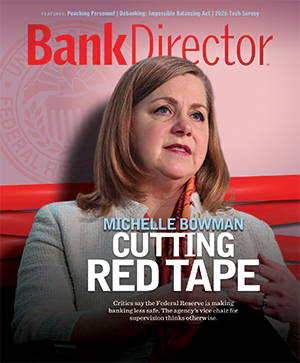
“One of the greatest challenges that I see with CECL is, how can you determine the probability of default when the industry has not seen a credit cycle since 2008?” says Robert “BJ” Goetz Jr., CEO of $1.2 billion Community Heritage Financial in Middletown, Maryland. “I think the intent is good, but [it] created inefficiencies and cost structures in an already cost-heavy industry.” CECL’s critics include Michelle Bowman, vice chair for supervision at the Federal Reserve. In a Sept. 8 op-ed for The Wall Street Journal, she criticized the rule as being overly burdensome and expensive for community banks, and said the FASB should allow smaller banks to opt for the incurred loss methodology.
The costs tied to the additional staff and technology needed to adopt and maintain CECL can be significant. In her op-ed, Bowman provided an example of a community bank that spent $475,000 on implementation, with annual expenses of more than $260,000. JP Shelly, a partner with Crowe, says implementing CECL challenged smaller banks that lacked large quantities of historical commercial loan loss data that could easily correlate to large macroeconomic events. While CECL does not prescribe a particular methodology, banks working with a limited data set leaned heavily on qualitative adjustments to their loan loss modeling, which in turn required a lot of time and cost to support. Many solved the problem by purchasing large sets of peer data and working with third parties.
Goetz says his institution hired a third-party vendor to run the modeling for CECL. After running CECL in parallel with the incurred loss methodology in 2022, the standard was in place by 2023. Now, he estimates the bank spends as much as $150,000 annually on loan loss modeling. For all that, he says CECL has not substantially changed his bank’s reserves nor provided any new insights into its loan portfolios.
And CECL remains untested. Goetz doubts the standard could adequately account for “singular catastrophic events” like the Covid-19 pandemic. Indeed, CECL had not been adopted across the industry when the pandemic hit, but banks that had adopted the standard by that time rapidly increased loan loss reserves compared to other institutions. Those reserves were later released when losses did not materialize.
Robert Sims, CEO of the $296 million Brattleboro Savings & Loan Association in Vermont, may be in a minority of bankers who prefer CECL to the incurred loss methodology, which he says did not provide as much of a framework as the current standard. While CECL requires more inputs and forecasting to implement, he sees it as no more burdensome than other types of data collection and analysis a bank would perform in its normal course of business.
“It’s no more work, in my opinion, than we would do on a moderate to complex commercial credit. And it’s work we should be doing anyway,” Sims says. “I feel better protected with my allowance for loan loss. I feel better reserved.”
The incurred loss model had some inherent flaws, says Gordon Dobner, a partner with Forvis Mazars. “You really only could consider things that had happened as of the balance sheet date, so if you feel like the economy is going to take a nosedive over the next year or two, and you’re seeing some bad signs out there… you can’t do anything about that in reality,” he says.
The FASB plans to publish a final report of its post-implementation review by year’s end, a spokesperson told Bank Director via email. The agency already eliminated a component of CECL that required banks to set aside extra capital for loans acquired via M&A, but Dobner thinks the standard is unlikely to change further until the next credit cycle puts it to the test.
Shelly offers a similar assessment. “Right, wrong or indifferent, CECL is here,” he says. “Generally speaking, the industry doesn’t want to move backwards.”
WRITTEN BY
Laura Alix
Director of Research
Laura Alix is the Director of Research at Bank Director, where she collaborates on strategic research for bank directors and senior executives, including Bank Director’s annual surveys. She also writes for BankDirector.com and edits online video content. Laura is particularly interested in workforce management and retention strategies, environmental, social and governance issues, and fraud. She has previously covered national and regional banks for American Banker and community banks and credit unions for Banker & Tradesman. Based in Boston, she has a bachelor’s degree from the University of Connecticut and a master’s degree from CUNY Brooklyn College.